
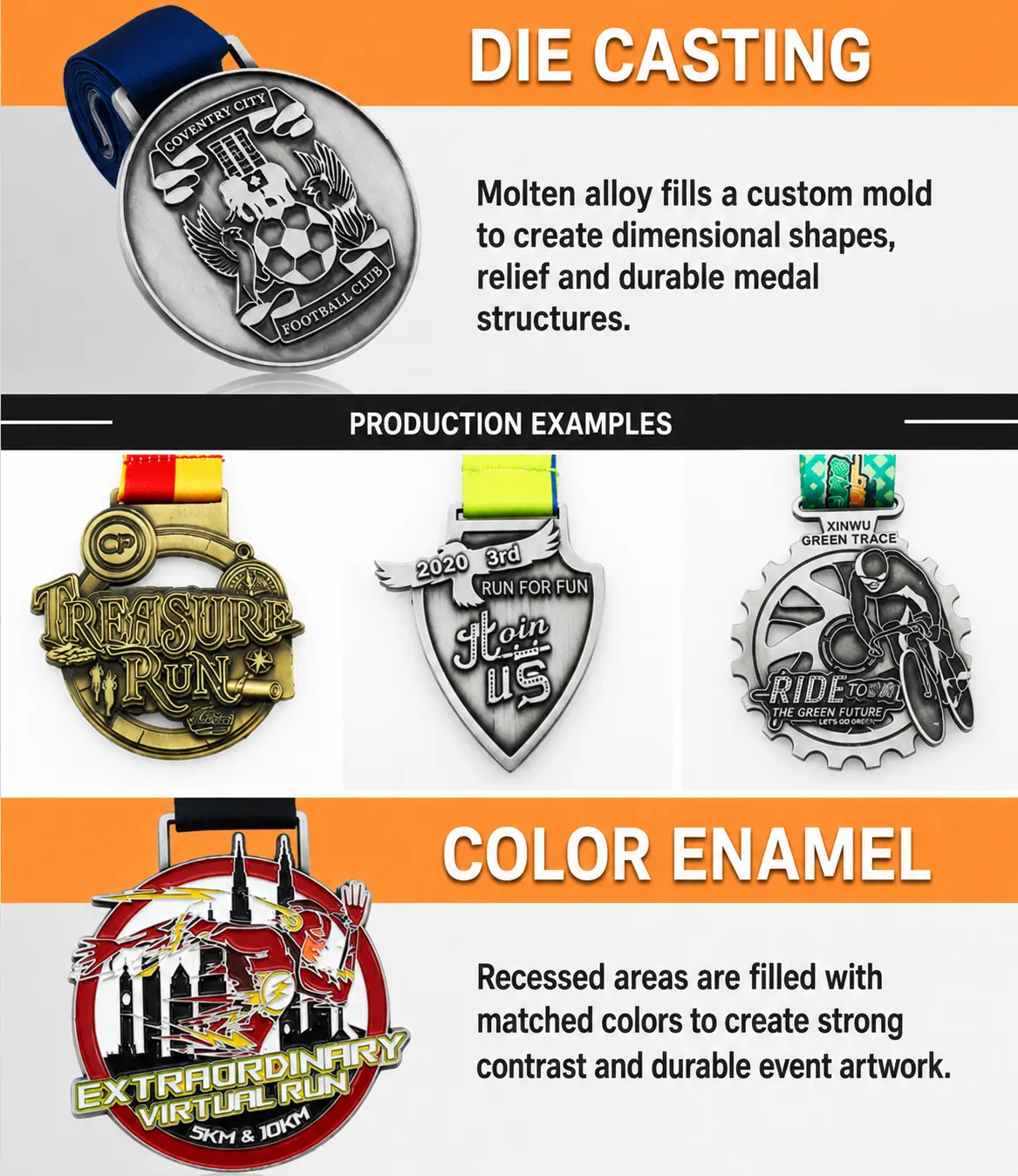
Die cast vs die struck medals: quick comparison
| Decision point | Die cast medals | Die struck medals |
|---|---|---|
| How the body is formed | Molten metal fills a mold. | A metal blank is pressed with tooling. |
| Common material direction | Zinc alloy is commonly considered. | Iron or brass may be considered. |
| Design geometry | Strong for custom outlines, thicker bodies and open areas. | Strong for flatter profiles and clean pressed details. |
| Relief | Useful for deep 2D steps and sculpted 3D transitions. | Useful for crisp low relief, lettering and defined borders. |
| Typical buyer fit | Race medals, dimensional awards and complex two-sided forms. | Traditional award pieces, badges and flatter commemorative designs. |
| Quotation check | Compare the same size, thickness, relief, color, finish, ribbon, packaging and quantity. | |
What are die cast medals?
For die casting, a mold creates the basic form and molten metal fills that cavity. This route gives a designer more freedom around the outer silhouette, internal openings and changing surface levels. It is widely considered for custom die cast medals that need a thicker appearance or a sculpted subject.
Zinc alloy die cast medals are a common planning direction because the material and forming method can support detailed custom forms. That does not mean every line or gap can be reproduced without limits. Very small openings, thin walls, deep undercuts and crowded text still need a manufacturing review.
A buyer should ask the factory to confirm which features are part of the mold, which are created by post-machining and which will be represented by enamel, printing, texture or plating.
What are die struck or stamped medals?
Die striking presses a metal blank with prepared tooling. Buyers may also see the terms die struck medals, stamped medals or custom stamped medals. Suppliers can use these terms differently, so the quotation should state the material, tooling method and finished thickness.
The method is useful when a design depends on clear lines, lettering, borders and controlled raised or recessed areas. It can work well for flatter medal forms and metal-only designs. Recessed areas can also be planned for enamel when the artwork provides practical metal boundaries.
Die striking is not automatically “less detailed” than casting. It produces a different type of detail. Clean graphic relief can be extremely sharp, while deep sculpted transitions or complex openwork are more naturally aligned with casting.
Match the process to the artwork, not the product name
A round medal with a logo and simple text may work with more than one forming route. A large irregular race medal with a deep landmark, layered scenery and open spaces may point toward die casting. A flatter brass-style commemorative award with crisp lettering may point toward die striking.
For relief decisions specifically, use the 2D vs 3D custom medals guide.
How forming method affects quotation and schedule
The process changes tooling, material use and production steps, but the forming method alone does not determine price. A smaller die-cast medal may cost less than a large die-struck medal with premium material and complicated finishing. A meaningful comparison keeps the specification constant.
Ask the supplier to separate any applicable tooling, sampling, product, ribbon, packaging and freight charges. Also confirm whether the quoted specification includes front and back relief, enamel fills, plating, polishing, attachment assembly and individual protection.
Timing depends on artwork readiness, proof revisions, tooling, sampling decisions, production quantity, finishing, inspection, packing and shipping. Request a project-specific schedule based on the required in-hand date.
What the production proof should show
- Finished outer dimensions and thickness
- Front, back and edge views
- Raised, recessed and sculpted areas
- Cut-outs and minimum metal walls
- Enamel or printed zones
- Plating and surface texture
- Ribbon connection and ribbon specification
- Any design changes made for manufacturability
The proof is the point where a buyer can catch a filled opening, softened corner, unreadable text or missing reverse-side detail before tooling and production continue.
Send a quote-ready forming brief
For a useful recommendation, send the vector artwork or clearest available file together with the quantity for each design, intended use, target dimensions, relief preference, color method, plating, ribbon, packaging, delivery country and required date. State whether a feature must be a true cut-out, a recessed area or only a visual color change.
Frequently asked questions
What is the main difference between die cast and die struck medals?
Die casting forms molten metal in a mold and is well suited to custom outlines, thicker bodies, cut-outs and sculpted relief. Die striking presses a metal blank with tooling and is well suited to flatter forms, crisp lines and controlled relief.
Which process is better for 3D custom medals?
Die casting is usually the more practical direction for deep or sculpted 3D relief, but the artwork, size and required detail must be reviewed before the process is confirmed.
Are all zinc alloy medals die cast?
Zinc alloy is commonly used for die-cast medals, but the final construction should be confirmed on the quotation and proof rather than assumed from a material name alone.
Can die struck medals include enamel color?
Yes. Recessed areas can be designed for suitable enamel fills when line widths, gaps and color boundaries meet production requirements.
Which option is cheaper?
There is no universal answer. Tooling, material, size, thickness, relief, cut-outs, plating, color, quantity and packing all affect the quotation.
What should I send for a process recommendation?
Send the artwork, quantity, intended use, target size and thickness, preferred relief, finish, ribbon, packaging, destination and required date.
Factory quotation · MOQ from 100 pieces
Need a Die Cast or Die Struck Recommendation?
Send the artwork, quantity, size, finish, ribbon, delivery country and required date. We will review the practical production route before quoting.