
Updated buyer answers · 2026-08-29
Questions buyers ask before they approve this specification
These answers expand the guide around the purchase decisions most likely to change price, production feasibility, quality control or the required in-hand date.
Are zinc alloy medals better than brass medals?
Neither material is universally better. Custom zinc alloy medals are often practical for complex shapes and dimensional die-cast work. Brass medals can suit crisp die-struck detail and a traditional metal feel. The artwork, dimensions, quantity, finish and budget determine which route is more efficient.
Which material should I choose for lightweight medals?
If low weight is important for children, mailed awards or very large formats, discuss aluminum or a thinner practical construction. Do not reduce thickness without checking rigidity, relief depth and ribbon balance. Ask the supplier to explain how the proposed material changes feel, edge appearance and finish options.
Do material and finish choices matter for a 100-piece order?
Yes. Tooling and setup are shared across fewer pieces, so unnecessary combinations can have a larger effect on a small order. Keep one clear material route, limit finishes that do not improve the design, and confirm whether each color or texture is enamel, print, plating or exposed metal.
The seven layers of a clear metal-product specification
How to discuss base metal without oversimplifying
Buyers often ask for “the best material,” but the practical choice depends on shape, thickness, relief depth, fine detail, weight, finish and quantity. The supplier should review the artwork before confirming the construction.
| Common direction | Typical planning use | What to confirm |
|---|---|---|
| Zinc alloy / die casting | Custom outlines, thicker medals, deep 2D or sculpted 3D relief and detailed two-sided forms. | Minimum wall thickness, relief depth, weight, plating coverage and mold construction. |
| Iron / stamping | Flatter badges and pins with defined lines, recessed color or die-struck metal areas. | Artwork line width, product thickness, cut-outs, plating and post placement. |
| Brass / die striking | Selected premium-looking badges, coins or commemorative pieces where crisp metal detail is important. | Availability, thickness, weight, tooling method, finish and unit-cost effect. |
Availability note: These are common industry planning directions, not a promise that every material is suitable for every design. Final construction should be confirmed against the approved artwork and quotation.
Die casting, stamping and die striking
For a decision focused on tooling and geometry, compare die cast vs die struck medals.
Die casting
Molten metal is formed in a mold, making it useful for custom outlines, thicker bodies and deeper relief. It is commonly considered for medals, coins and dimensional pieces.
Stamping or die striking
Metal is pressed with tooling to create the shape and relief. It is often considered for flatter badges, pins and clean die-struck details. The artwork must respect practical line, gap and edge limits.
Soft enamel, imitation hard enamel and printing
| Color method | Appearance | Good fit | Buyer check |
|---|---|---|---|
| Soft enamel | Color sits below the raised metal lines, creating a tactile recessed surface. | Bold logos, event pins, badges and designs that benefit from visible metal separation. | Color count, fill areas, recess depth and whether epoxy is requested. |
| Imitation hard enamel | Color is polished close to the metal lines for a smoother, jewelry-like face. | Premium brand marks, membership pins, formal recognition and retail collections. | Fine detail, color boundaries, polishing and plating compatibility. |
| Printing | Supports gradients, photographs or very fine artwork that cannot be separated into enamel cells. | Detailed logos, small text, complex color transitions and selected promotional designs. | Print resolution, base color, protective layer and edge treatment. |
For a medal-specific comparison, read soft enamel vs hard enamel medals. For gradients and photographs, compare UV printed vs enamel medals.
2D, 3D and mixed relief
2D relief uses defined raised and recessed levels. It is usually clearer for logos, text, borders and geometric designs. 3D relief uses gradual height transitions for faces, figures, animals, architecture and sculpted forms.
A mixed construction may keep text and logos in 2D while using 3D for a central figure. This can improve readability without losing dimensional impact. Compare the options in the 2D vs 3D custom medal guide.
Plating and surface-finish directions
| Finish direction | Visual effect | Common planning use |
|---|---|---|
| Polished gold, silver or nickel | Bright reflections and clean highlights. | Modern awards, corporate recognition, retail pins and high-contrast enamel designs. |
| Black nickel | Dark reflective metal lines and a contemporary appearance. | Dark artwork, fashion merchandise and designs requiring strong color contrast. |
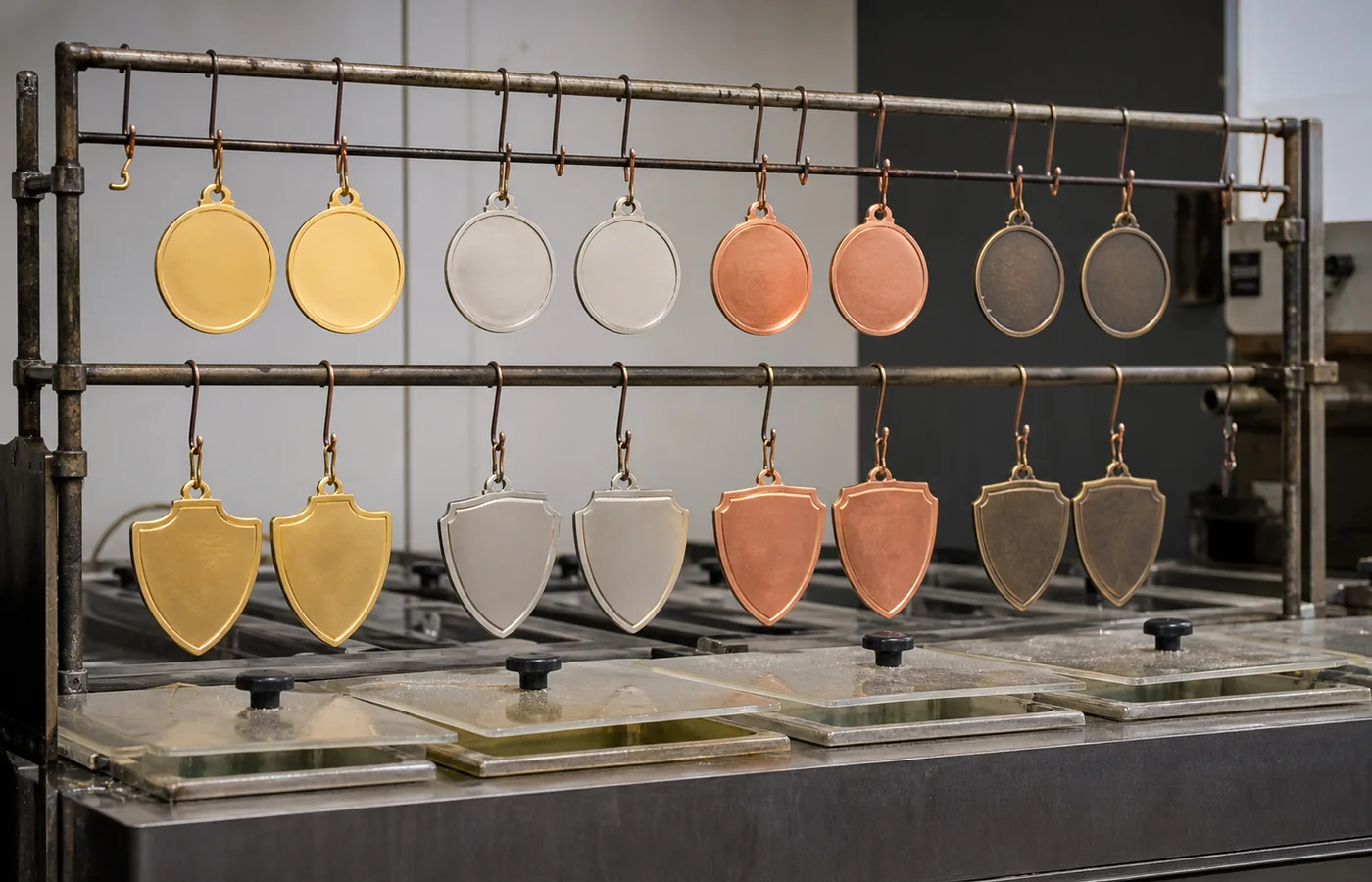
| Antique gold, silver, brass or copper directions | Darkened recesses emphasize relief and reduce mirror-like reflection. | Heritage events, sports medals, commemorative coins and sculpted artwork. |
| Satin or brushed direction | Softer reflected light and lower visual glare. | Formal awards, clean metal-only designs and understated branding. |
| Sandblasted recesses | Fine matte texture contrasts with polished raised areas. | Textured medals, coins and premium two-tone metal effects. |
| Dual finish | Two visually different metal directions on one product where technically suitable. | Designs needing stronger hierarchy or separation between elements. |
Plating names can vary between suppliers. Ask for a physical sample, plating reference or clear approved proof when appearance is critical. Use the dedicated custom medal plating finishes guide to compare bright, antique, black nickel, matte and dual-tone directions.
When epoxy can help—and when it changes the design
A clear epoxy dome can protect selected printed or soft-enamel surfaces and creates a rounded glossy appearance. It also changes the feel and reflection of the face. Do not add it automatically; decide whether the project needs a domed surface or prefers the original metal-and-enamel texture.
Match the specification to the product
| Product | Common decision priorities | Related page |
|---|---|---|
| Custom medals | Diameter, thickness, 2D/3D relief, plating, ribbon, weight and packaging. | Custom Medals |
| Enamel pins | Soft vs hard enamel, line width, color cells, post layout, clutch and backing card. | Custom Enamel Pins |
| Metal badges | Die-struck detail, enamel or metal-only areas, attachment and wearing method. | Custom Metal Badges |
| Challenge coins | Diameter, thickness, two-sided relief, edge treatment, plating and presentation packaging. | Challenge Coins |
What to include in a materials and finishes RFQ
- Product type and quantity for each design
- Vector artwork, clear logo file or dimensioned sketch
- Target size and thickness
- Preferred 2D, 3D or mixed relief
- Color process and approximate number of colors
- Preferred plating and surface texture
- Ribbon, clutch, magnet, keyring or other attachment
- Packaging requirement
- Delivery country and required date
Common mistakes to avoid
- Choosing a finish name before confirming whether it supports the artwork.
- Using 3D relief for small text that needs crisp readability.
- Approving a front view without confirming the back, edge and attachment.
- Assuming all “gold” or “antique silver” samples look identical across suppliers.
- Adding epoxy without considering the glossy domed appearance.
- Comparing quotations that use different thicknesses, materials, packaging or shipping terms.
Frequently asked questions
Which material is best for a custom medal?
There is no single best material. The right direction depends on size, relief, artwork, weight, finish, quantity and budget. Confirm the construction with the supplier before approving the proof.
What is the difference between polished and antique plating?
Polished plating reflects more light and looks clean and bright. Antique finishes darken recessed areas to emphasize relief and create a more traditional or commemorative appearance.
Should I choose soft enamel or hard enamel?
Soft enamel retains recessed color areas and visible metal lines. Imitation hard enamel is polished closer to the metal lines for a smoother surface. Choose according to artwork, appearance, use and budget.
Can a medal use both 2D and 3D relief?
A mixed construction may be possible when the design needs readable flat text together with sculpted figures or objects. Confirm feasibility during artwork review.
Does epoxy make every product more durable?
Epoxy can add a clear rounded protective layer over printed or selected color areas, but it changes the surface appearance and is not automatically the best choice for every design.
What should I send for a recommendation?
Send the artwork, product type, quantity, target size and thickness, preferred appearance, attachment or ribbon, packaging, destination and required date.
Factory quotation · MOQ from 100 pieces
Request a Specification-Based Material and Finish Quote
Send one written specification covering quantity, artwork, size, finish, ribbon or attachment, packing, destination and required in-hand date. We will review feasibility before quoting.