
UV printed vs enamel medals: quick comparison
| Decision point | UV printed medals | Enamel medals |
|---|---|---|
| Color capability | Full-color graphics, gradients and photographic detail. | Separated solid colors with approved references. |
| Artwork structure | Does not require a metal boundary around every printed color. | Color cells normally need practical metal separation. |
| Surface feel | Flatter printed surface, with any protection method confirmed. | Textured soft enamel or smoother polished hard enamel. |
| Fine detail | Useful for small sponsor marks and dense artwork. | Useful for bold logos, numbers, names and graphic shapes. |
| Metal character | Printed artwork can cover selected surface areas. | Raised or polished metal lines remain part of the design. |
| Best next step | Review the design at actual medal size before choosing the process. | |
What are UV printed medals?
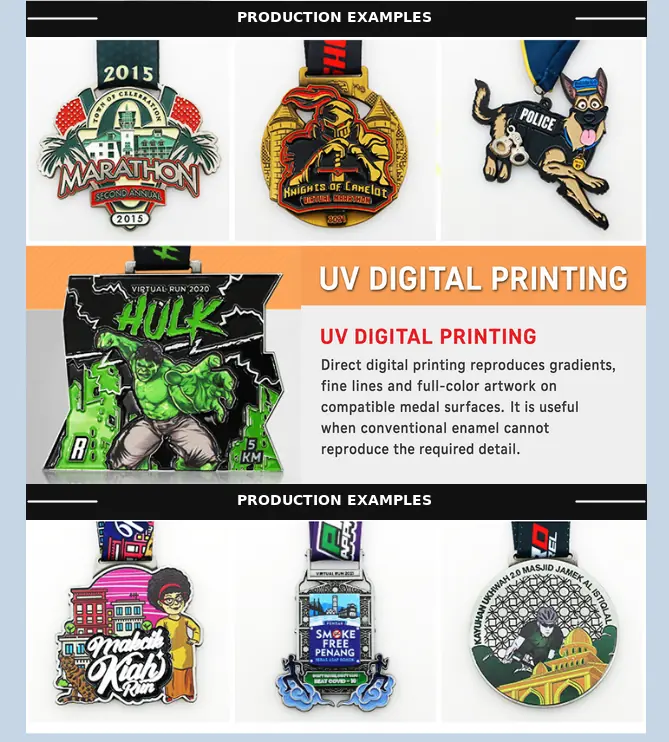
UV printed medals use digitally applied color that cures on the product surface. The process can reproduce gradients, illustrations, photographs and color transitions that are not practical as traditional enamel fills.
Custom UV printed medals are especially useful when an event identity comes from a full-color poster, a scenic image or multiple sponsor logos. Printing can also support fine reverse-side information that would become crowded if every color needed a raised metal boundary.
The metal body still needs its own forming, relief and plating specification. UV printing is a color process, not a replacement for deciding the medal size, thickness, shape, front/back relief, ribbon and packaging.
When enamel is the better choice
Custom enamel medals are a strong fit when the design uses clear solid color areas and the buyer wants visible metal outlines. Soft enamel creates recessed color and tactile ridges; imitation hard enamel is polished for a smoother face.
Enamel can give a medal a recognizable award-product character because metal and color remain visibly separate. Bold event names, large numbers, team marks and simple icons are often easy to translate into enamel cells.
Enamel is not intended to create a smooth photographic gradient. Converting a complex image into enamel may require fewer colors, stronger outlines and simplified detail.
Use the artwork to make the decision
Confirm how the printed surface will be protected
Printed detail sits differently from enamel. Ask which protective method is proposed for the selected surface, how it changes gloss and whether it covers the complete face or only a defined area. A clear epoxy layer may be discussed, but it creates a rounded glossy appearance and can reduce the direct feel of metal texture.
Protection should be chosen from the actual handling environment. Race medals may be packed and distributed in volume; retail presentation pieces may use individual packaging; commemorative items may be handled less often. The packing method also helps prevent printed faces from rubbing during transport.
Three practical hybrid constructions
Soft enamel front, UV printed back
Use the front for the event mark and raised metal texture, then print sponsor logos, a route, QR code or detailed campaign artwork on the back.
3D relief with selected UV detail
Keep the main figure or landmark in plated 3D relief and print color in suitable flat or controlled areas. The proof must show how the print aligns with the relief.
Enamel color cells with printed accents
Use enamel for the largest brand colors and add print only where gradients or fine secondary marks are necessary. This can preserve the medal-like surface without simplifying every detail.
How to approve color without confusing print and enamel
Enamel is typically discussed as solid approved color fills. Digital print builds color through a printing workflow and may look different on screen, on paper and on the plated medal surface. Send original artwork and clearly identify critical brand colors.
If color accuracy is commercially important, agree on the reference and approval method before production. A digital proof is essential for layout and process zones, while a relevant physical sample or reference may be needed for appearance that cannot be judged on screen.
What to send for a UV printed medal quote
- Original vector logo files and high-resolution raster artwork
- Quantity for every design and version
- Finished size, thickness and intended use
- Front and back artwork with print zones identified
- Any required 2D or 3D relief
- Preferred plating and surface texture
- Whether enamel is also required
- Ribbon, packaging, destination and required date
Frequently asked questions
When should I choose UV printed medals?
Choose UV printing for gradients, photographs, complex multi-color graphics, small sponsor logos or details that cannot be separated into practical enamel cells.
When is enamel better than UV printing?
Enamel is better when the design uses solid color areas separated by metal lines and the buyer wants a traditional textured or polished metal-and-color surface.
Can UV printing reproduce Pantone colors?
Printed and enamel color are produced differently. Provide original artwork and color references, then approve a process-specific proof or sample when color is critical.
Do UV printed medals need epoxy?
A clear protective layer may be recommended for selected printed areas, but it changes gloss and surface feel. Confirm the proposed protection for the specific design.
Can one custom medal combine UV print and enamel?
Yes. Enamel can be used for bold front-side colors and UV print for gradients, sponsor logos, QR codes or detailed reverse-side artwork.
What artwork file is best for UV printed medals?
Provide the highest-quality original artwork available, preferably vector for logos and high-resolution raster files for photographic detail.
Factory quotation · MOQ from 100 pieces
Need UV Print, Enamel or Both?
Send the original artwork, quantity, size, finish, ribbon, delivery country and required date for a process recommendation.