
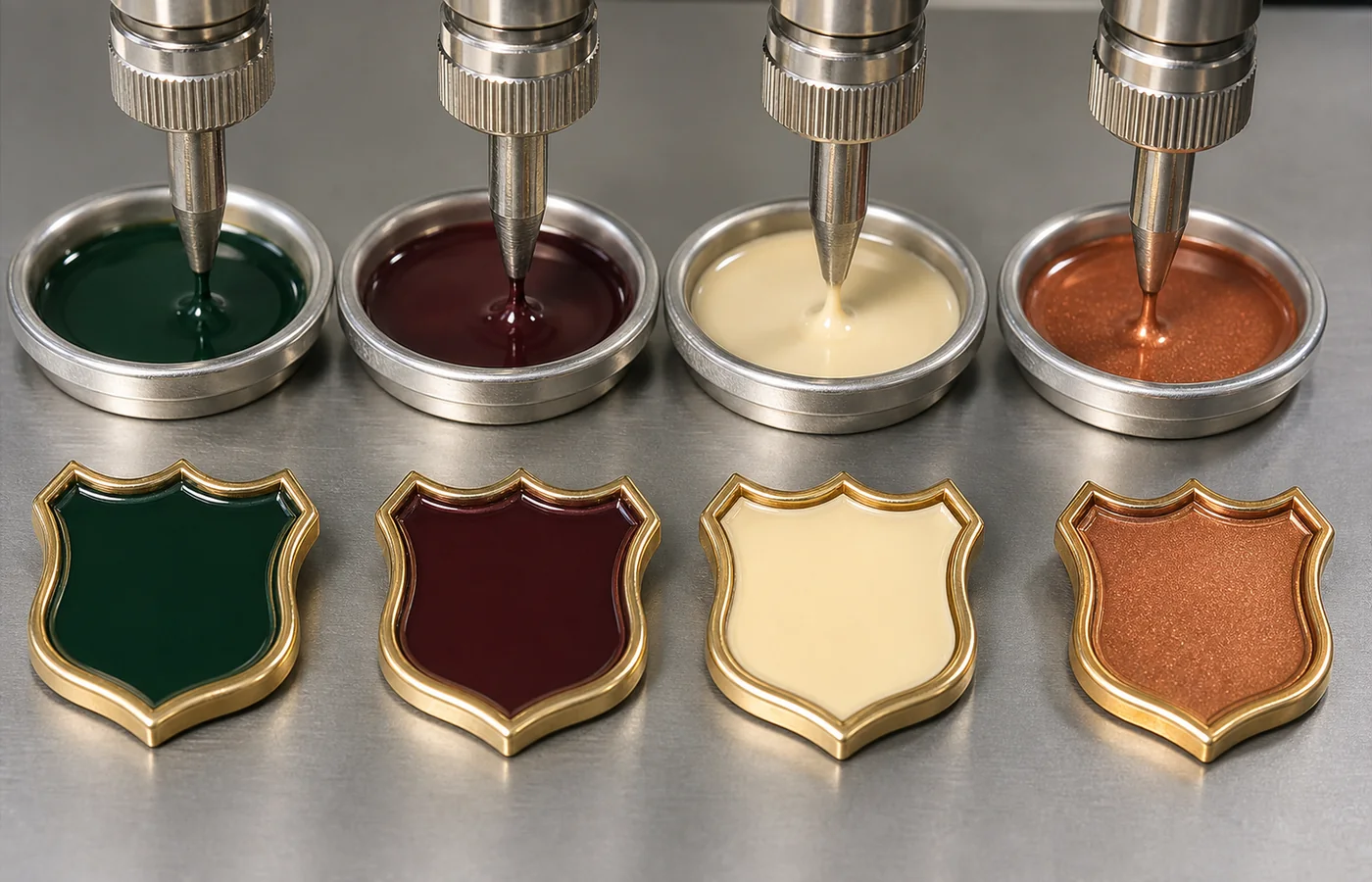
Soft enamel vs hard enamel medals: quick comparison
| Decision point | Soft enamel medals | Hard enamel medals |
|---|---|---|
| Surface | Recessed color with raised metal lines. | Color polished closer to the metal lines. |
| Feel | Textured and dimensional. | Smoother and more jewelry-like. |
| Artwork style | Bold solid color cells and visible metal separation. | Clean solid color areas suited to polishing. |
| Typical visual use | Sports, races, clubs and energetic event graphics. | Corporate awards, formal recognition and premium presentation. |
| Gradients and photos | Not reproduced as conventional enamel fills. | Not reproduced as conventional enamel fills. |
| Quote check | Confirm the exact enamel system, material, plating, color count, polishing and any protective layer. | |
What is a soft enamel medal?
A soft enamel medal uses solid color fills in recessed cells. Raised metal lines separate the colors and remain visibly higher, giving the surface a texture that can be seen and felt. This structure is useful when a design depends on strong borders, readable event text and clearly separated logo colors.
Custom soft enamel medals are often considered for race medals, sports awards, school events and large color-forward designs. The practical artwork question is whether every color area has a metal boundary and enough space to fill cleanly at the finished size.
Soft enamel can be left with its natural recessed texture. A clear epoxy layer may be discussed for selected projects, but it changes the gloss and feel and should not be added automatically.
What is a hard enamel medal?
In many custom medal quotations, “hard enamel” refers to imitation hard enamel. Color is filled and the surface is polished so the enamel sits closer to level with the metal lines. The result is smoother and visually more refined.
Custom hard enamel medals may be suitable for corporate awards, anniversaries, membership recognition or presentation pieces where a flat polished face is more important than deep texture. The polishing step also means the artwork must be compatible with the selected metal construction, line widths and finish.
Terminology varies. Ask the supplier to state the exact enamel type, base material and polishing process on the quotation. A process name without a construction specification is not enough for a like-for-like comparison.
Which enamel is best for your artwork?
The best enamel for custom medals is the one that reproduces the design at the finished size while meeting the intended look, handling and budget. If the artwork has many small colors, ask for a simplified enamel version and a printed alternative before approval.
Durability depends on the complete construction
Buyers sometimes assume the word “hard” guarantees a stronger medal. Surface smoothness is only one part of the product. Base metal, forming, plating, enamel adhesion, edge protection, packing and event handling also matter.
A polished hard-enamel face can reduce exposed height differences, while soft enamel keeps distinct metal ridges around the color. Both can be suitable for normal award use when the artwork and production are controlled. For bulk events, individual protection and carton packing can be as important as the color process because medals may rub against each other during shipment.
How enamel choice affects the quotation
Hard enamel generally includes additional filling and polishing work, but no fixed percentage should be assumed. The quotation also depends on medal size, thickness, relief, number of colors, plating, ribbon, packaging and quantity. Ask for both options using the same body and accessories if you want a useful comparison.
Lead time also depends on proof revisions, production load and the rest of the specification. Confirm an order-specific schedule rather than relying on a generic number.
What to check on the enamel proof and sample
- Each Pantone or approved color reference
- Metal boundaries between color areas
- Minimum line, gap and text size at actual scale
- Areas that remain recessed or are polished smooth
- Plating around metal lines and outer edges
- Front and back color processes
- Any epoxy or protective coating
- Ribbon color and printing method
If surface feel is central to the buying decision, request a relevant physical reference or discuss sampling before bulk production.
When a hybrid enamel and printing route makes sense
One medal can combine processes when the design needs both classic metal texture and fine full-color detail. For example, the front can use soft enamel for the event mark while the reverse uses UV printing for sponsor logos, a route map or a gradient. A suitable 3D feature can remain uncolored while surrounding areas use enamel.
The proof should identify each process zone clearly. Do not approve a full-color visual that does not distinguish enamel cells, printed areas and plated metal.
Frequently asked questions
What is the difference between soft enamel and hard enamel medals?
Soft enamel leaves color below raised metal lines, creating a textured surface. Imitation hard enamel is filled and polished closer to the metal lines, creating a smoother face.
What is a soft enamel medal?
It uses recessed color areas separated by raised metal lines. The visible height difference creates a tactile, dimensional surface.
What is a hard enamel medal?
In many custom medal quotations, hard enamel refers to imitation hard enamel: color is filled and polished closer to level with the metal lines. Confirm the exact process.
Which enamel is best for custom race medals?
Soft enamel is often practical when bold colors and raised texture matter. Hard enamel may suit a smoother premium face. The artwork and budget should decide.
Can one medal use enamel and UV printing?
Yes. Enamel can handle bold color cells while UV printing handles gradients, small sponsor marks or detailed reverse-side artwork.
Does hard enamel always last longer?
Not automatically. Overall durability also depends on the metal body, plating, handling and packing. Confirm the complete finished specification.
Factory quotation · MOQ from 100 pieces
Need a Soft or Hard Enamel Recommendation?
Send the artwork, quantity, size, colors, plating, ribbon, delivery country and required date for a practical process review.