
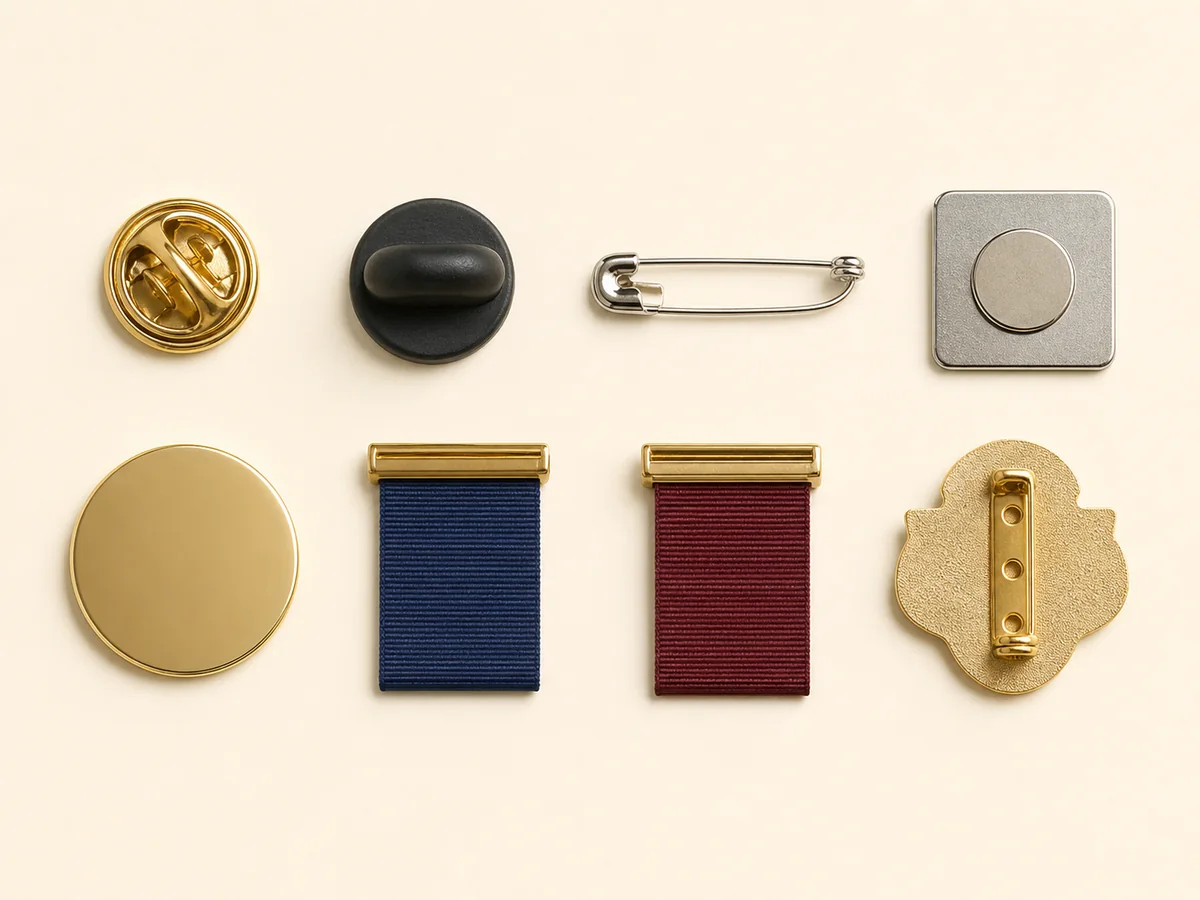
Backing comparison
| Backing | Suitable for | Important check |
|---|---|---|
| Butterfly clutch | General lapel pins and promotions | Post length, metal finish and holding force |
| Rubber clutch | Casual merchandise and comfortable handling | Color, grip and long-term fit |
| Locking clutch | Higher-security or heavier pins | Removal method and added height |
| Safety pin | Name badges, brooch-style items, larger badges | Orientation, soldering and garment contact |
| Magnet | Uniforms or garments where holes are undesirable | Weight, magnetic strength and use restrictions |
| Adhesive backing | Selected flat decorative applications | Surface compatibility and expected service life |
One post or two posts
A small balanced pin may work with one post. Wide, tall or asymmetrical designs may rotate unless two posts are used. The digital proof should show post positions and confirm that they do not interfere with recessed areas or thin edges.
Magnetic backings
Magnets can avoid piercing fabric, but they add weight and may not suit every environment or user. Confirm holding strength through the intended garment and consider warnings or restrictions for sensitive equipment and medical devices.
Safety pin and brooch styles
Safety pins and brooch fittings suit larger badges and formal accessories. Check the direction of the bar, locking action, solder points, sharp edges and how the product sits on clothing.
Backing cards and retail packaging
Backing cards can protect posts and improve retail presentation. Confirm card size, paper, print, hole or slit positions, barcode area and whether the pin is attached before packing. The card design should leave enough room for the backing hardware.
Selection checklist
- How and where will the product be worn?
- What is the finished size and weight?
- Could the design rotate with one post?
- Must the garment remain unpunctured?
- Will the product be sold on a card?
- Are there safety or user restrictions?
Which backing should a factory quote for your badge or enamel pin?
Tell the manufacturer whether this is a custom metal badge for a school, club or uniform, or a decorative enamel pin for brand merchandise. Those use cases can lead to different attachment choices even when the front artwork looks similar.
Short sourcing answer: For a lightweight lapel pin, compare rubber and metal butterfly clutches. For an asymmetric badge, ask whether two posts help reduce rotation. For a staff badge that must not puncture fabric, discuss a suitable magnetic option and garment conditions. Confirm backing location, safety considerations, sample appearance and per-design quantity before production.
Ask our Dongguan team to compare backing options for your pin or badge →
Updated buyer answers · 2026-08-29
Questions buyers ask before they approve this specification
These answers expand the guide around the purchase decisions most likely to change price, production feasibility, quality control or the required in-hand date.
Is a rubber clutch or butterfly clutch better for enamel pins?
Rubber clutches feel soft and are available in different colors; metal butterfly clutches have a familiar spring grip. Neither is automatically best. Match the clutch to wearing comfort, removal frequency, product positioning and budget, then inspect how securely it fits the specified post.
When should a custom enamel pin use two posts?
Two posts can reduce rotation on wide, tall or asymmetrical pins and can distribute load more evenly. They also create two holes in fabric and require precise placement. Show both post positions on the production proof and check that neither interferes with recessed areas or edge detail.
Are magnetic pin backings suitable for every buyer?
No. Magnets avoid puncturing fabric and can suit some badges or name applications, but holding strength depends on magnet construction, product weight and fabric thickness. They may also be inappropriate around certain medical devices or child-use contexts, so confirm the intended user and applicable safety requirements.
Common buyer questions
Common questions
Which backing is most common for enamel pins?
Butterfly and rubber clutches are common, but the correct option depends on pin weight, use, security and packaging.
Do large pins need two posts?
Often, two posts reduce rotation and distribute the load. The final position should be confirmed from the artwork.
Are magnets suitable for every customer?
No. Consider garment thickness, holding strength, product weight and potential restrictions around medical devices or sensitive equipment.
Can backing cards be customized?
Yes. Send the card dimensions, print artwork, material direction and packing requirements for quotation.
Factory quotation · MOQ from 100 pieces
Request a Specification-Based Enamel Pin Backing Quote
Send one written specification covering quantity, artwork, size, finish, ribbon or attachment, packing, destination and required in-hand date. We will review feasibility before quoting.