
Why fixed-date events need a different supplier check
A product launch can sometimes move; a marathon, tournament or conference usually cannot. Late medals affect the finish-line experience, volunteers, sponsor commitments and participant trust. That makes schedule evidence as important as the unit price.
Factory-direct sourcing can shorten the path between artwork questions and production decisions, but the words factory direct are not proof. Buyers should verify what work is actually controlled, which processes may be subcontracted and who owns the final delivery plan.
Verify identity before capability claims
Ask for the legal company name, factory location, business contact information and current audit or quality documents relevant to the supplier's claims. Check that the website, quotation, invoice and payment instructions identify the same business relationship.
Review the site's certifications and compliance page and request current documents for a qualified project review. Do not treat a logo or certificate name on a website as complete verification.
Ask for evidence tied to your product
| Evidence | What it should clarify |
|---|---|
| Production photos or video | Relevant medal, pin, coin or metal-gift processes—not unrelated machinery. |
| Digital proof | Dimensions, front/back artwork, finish, colors, ribbon and attachment. |
| Sample or approval piece | How the confirmed construction will look and feel before bulk production. |
| Inspection record | What was checked against the approved specification. |
| Packing evidence | Quantity, individual protection, carton labels and shipping readiness. |
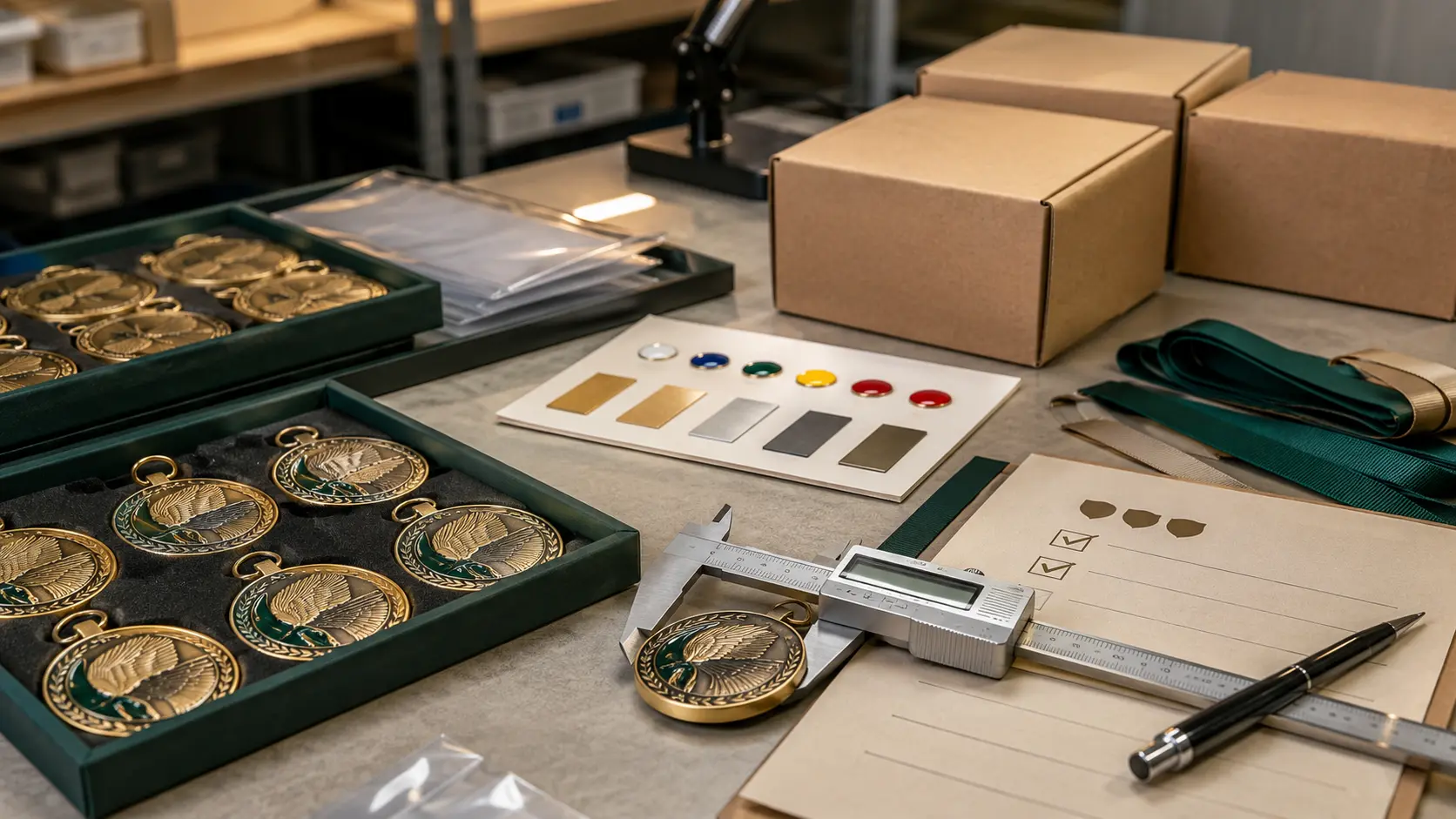
See the actual factory production line and quality-control workflow.
Compare quotations on the same specification
A lower price may reflect a smaller size, thinner metal, different process, simpler ribbon, bulk packing or different shipping term. Send the same written RFQ to each supplier and require the quotation to identify what is included.
Compare material, dimensions, mold or tooling, color process, plating, ribbon, assembly, packaging, sample, inspection, trade term and destination charges. A headline unit price without these details is not a like-for-like comparison.
Control artwork and change deadlines
Set one approval owner and one final artwork file. Confirm the last date when sponsor logos, spelling, distance, year or colors can change without affecting the schedule. After tooling or bulk production begins, late changes may require rework or a new setup.
Ask the supplier to highlight minimum line widths, small gaps, tiny text, unsupported gradients and weak cut-out bridges before approval. The factory should translate the concept into production constraints, not simply accept an artwork file without review.
Use milestone communication instead of vague updates
A useful order update is tied to a checkpoint: artwork approved, tooling complete, first piece checked, bulk finish confirmed, ribbons assembled, quantity counted, packing complete and shipment released. Agree on which checkpoints include photos or videos.
This structure is more valuable than daily messages that do not prove progress. It also gives the event team a clear time to review sponsor presentation, carton grouping and distribution needs before shipment.
Build a delivery plan with buffer
Confirm production and shipping as separate parts of the schedule. Record the trade term, pickup point, destination, shipping mode, carton count and who handles customs or local delivery. Keep an arrival buffer for venue receiving and event preparation.
For repeat annual events, preserve the approved artwork, mold reference, finish, ribbon specification and packaging instructions. A controlled reorder file can reduce uncertainty next year.
Factory verification checklist
- Legal identity and matching quotation/payment details.
- Actual production evidence relevant to the product.
- Written specification and digital proof.
- Sampling route and approval owner.
- Milestone production updates.
- Color, plating, dimensions and attachment checks.
- Quantity, packing and carton-label confirmation.
- Trade term and shipping responsibility.
- Required in-hand date and arrival buffer.
- Document control for repeat orders.
For a broader supplier review, use the custom medal manufacturer verification guide.
Frequently asked questions
How can I tell whether a medal supplier is a real factory?
Verify the legal identity, location, relevant production evidence, quotation details and ability to explain the manufacturing and inspection steps for your exact product.
Does factory direct always mean the lowest price?
No. Compare the complete specification, quality control, packaging, trade term and shipping responsibilities. A lower headline price may exclude important items.
What production evidence should an event organizer request?
Request proof approval, relevant production photos or video, finish and color checks, quantity confirmation, packing evidence and carton labels.
Should I order a physical sample?
A sample is useful for new suppliers, complex designs or high-profile events, but it adds time. Decide early who approves it and how revisions affect the schedule.
What is the minimum order?
Minimum order starts from 100 pieces. The exact setup depends on design, process, finish and product type.
What should be included in a factory quotation?
Quantity, dimensions, material, process, plating, colors, ribbon or attachment, packaging, sample terms, trade term, production estimate and shipping basis.
Factory quotation · MOQ from 100 pieces
Compare a Factory Quote with Real Evidence
Send one written specification to compare materials, size, finish, ribbon, packing, inspection, trade term and delivery plan on the same basis.