
Updated buyer answers · 2026-08-29
Questions buyers ask before they approve this specification
These answers expand the guide around the purchase decisions most likely to change price, production feasibility, quality control or the required in-hand date.
Where can I order 100 custom enamel pins with my logo?
Use a supplier that clearly accepts a 100-piece starting quantity and asks for artwork, finished size, enamel direction, plating, backing and packaging. Verify where production occurs and how the proof is approved. Avoid choosing only from a headline unit price that omits tooling or delivery.
Why do 100 custom pins cost more per piece than 500?
Artwork preparation, mold making and machine setup are spread across fewer pins. This does not make a 100-piece order unsuitable; it means the buyer should test one strong design and avoid unnecessary color or packaging versions. Compare 100 and larger quantities with the same specification.
What should a first small-batch enamel pin brief include?
Provide the logo or artwork, intended size, soft or hard-enamel look, plating, quantity, one or two posts, clutch type, backing card or bag, destination and required date. If you are unsure, state how the pin will be used and let the factory identify practical options before proofing.
Yes. Custom Medals & Badges accepts custom enamel pin orders starting from 100 pieces. A 100-piece run can be practical for product testing, clubs, independent artists and limited releases when the design and packaging are specified carefully.
Why do many enamel pin factories avoid very small quantities?
A custom pin is not selected from a shelf. The supplier must review artwork, decide how metal lines will separate colors, prepare production artwork, make a mold or production setup, select plating, arrange enamel colors, finish the surface, attach hardware and inspect the run. Many of those activities take place whether the order contains 50 pieces or 5,000.
Factories therefore use a minimum quantity or a minimum spend to cover setup and make production scheduling practical. For a buyer, the useful question is not whether setup exists. It is whether the supplier explains it clearly and whether the proposed product can be simplified without losing the design’s identity.
Is a 100-piece enamel pin order viable?
Yes, especially for a first product test, a small membership group, a limited artist release or an event with controlled attendance. A 100-piece run lets you learn how the finished size feels, how the colors read on metal, how the clutch behaves and whether customers accept the retail price before holding deeper inventory.
The total order still needs to absorb tooling, production and international shipping. That means a 100-piece order should be deliberate. Use one clear design, avoid unnecessary colourways, choose packaging that matches the sales channel and compare the landed total with the likely number of sellable pieces.
How does a mold fee affect the cost of 100 pins?
A mold converts the approved artwork into the metal structure of the pin. It is a fixed project cost rather than a cost that rises directly with every piece. When that fixed amount is divided across 100 pins, its effect per pin is larger than when it is divided across 500.
Ask the quotation to separate product, tooling or setup, packaging and shipping where practical. Also ask how a future reorder of the same approved design would be handled. Do not assume a mold is stored forever or that every process treats repeat orders the same way; obtain order-specific confirmation.
How should you choose soft enamel or hard enamel?
Soft enamel is filled below the metal lines, so a fingertip can feel the recessed color areas. It often suits bold outlines, graphic characters and buyers who want visible metal texture. Hard enamel is filled and polished to a smooth level surface. It can feel more jewelry-like and works well for clean brand marks and gifts.
Neither is automatically better. Thin lines, very small gaps and complex color boundaries may need artwork adjustment in either process. Ask the supplier to identify risky detail in the proof instead of approving an attractive screen image that cannot be reproduced reliably at the chosen size.
How can a small-batch buyer control cost?
Start with the design’s essential feature. Keep the pin within a practical size, limit color versions, use a standard clutch, and choose individual bags or a simple backing card if presentation packaging is not central to the offer. One strong plating finish is usually easier to manage than several finish variants.
Compare 100, 250 and 500 pieces using the same specification. A lower unit cost at 500 does not automatically make it the better decision: the extra inventory must be sold, stored and protected. Evaluate total cash outlay, expected sell-through, replacement allowance, freight and import costs together.
What should you provide for an accurate quotation?
Send the finished quantity for each design, target width or height, preferred soft or hard enamel, plating direction, number of colors, clutch type, packaging, required date and delivery country. Attach vector artwork if available. If you only have a logo or sketch, explain which elements are fixed and which can be adapted for production.
Tell the supplier whether the pin will be sold, gifted, worn on a thick jacket or mounted on a presentation card. That context can change the recommended size, number of posts, attachment and packaging.
How do you avoid a pin that differs from the proof?
Read the digital proof as a specification, not only as a picture. Check dimensions, metal color, enamel references, front and back, post position, clutch, printed detail and packaging. Confirm whether line thicknesses and small gaps have been adjusted for production. Ask how recessed and raised areas will feel.
A screen cannot perfectly simulate metal reflection, plating variation or physical enamel. When the visual risk is high, discuss a physical sample and its cost and timing. Keep the approved proof and written specification together so inspection has a shared reference.
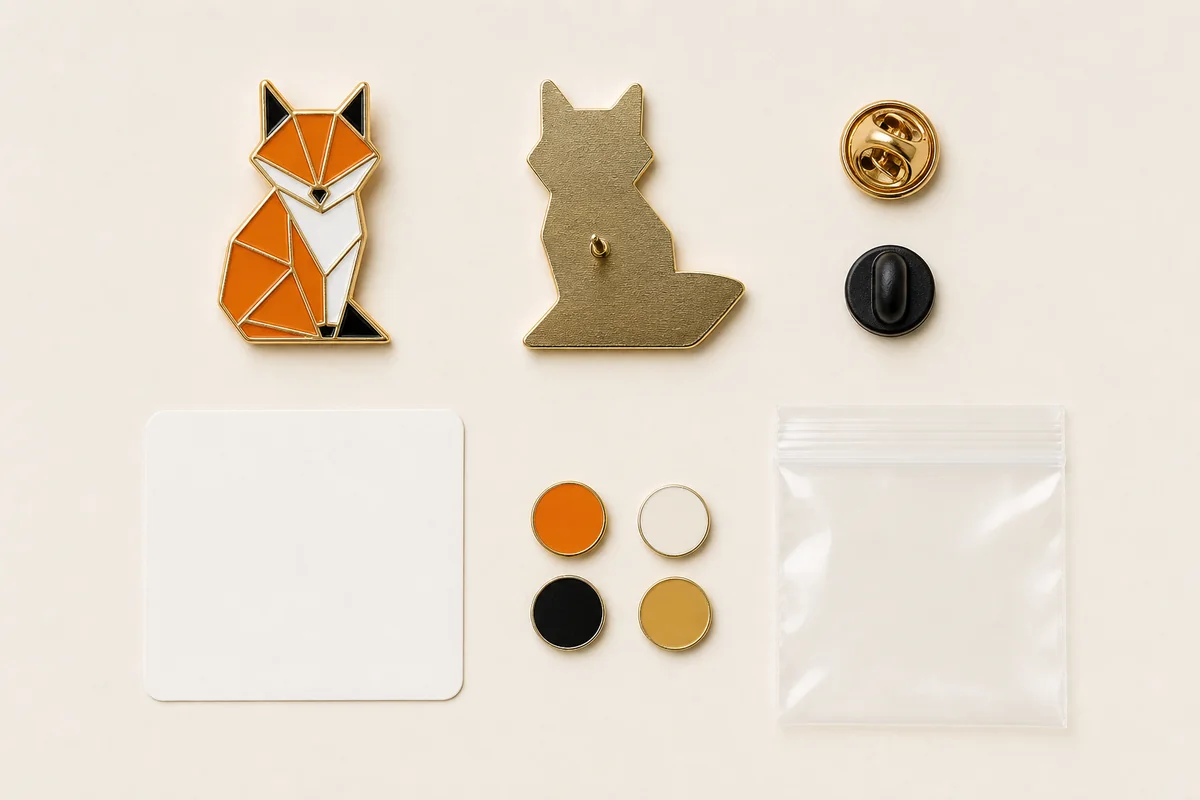
Buyer comparison and checklist
| Decision | Lower-complexity direction | Question to ask |
|---|---|---|
| Design count | One design | Does every design need separate tooling? |
| Size | A practical compact size | Which details become too small? |
| Color | Focused palette | How are color references recorded? |
| Attachment | Standard clutch | Is one or two posts recommended? |
| Packaging | Individual bag or simple card | What card dimensions fit the pin? |
| Quantity | Compare 100, 250 and 500 | What is the total landed cost at each quantity? |
Frequently asked questions
Can I really order only 100 custom enamel pins?
Yes. Minimum order starts from 100 pieces. A 100-piece run is often used for product testing, an artist release, a club or a focused event.
Are 100 pins much more expensive per piece than 500?
Fixed setup activity is spread across fewer pieces, so the unit cost is generally higher at 100 than at 500. Request both quantities if you want to compare the total spend and unit economics.
Does every pin require a mold fee?
Custom metal production commonly involves tooling or setup, but the treatment depends on product and artwork. The quotation should state whether a mold or setup charge applies.
Should I choose hard enamel or soft enamel for a first order?
Choose by surface, detail, appearance and budget. Soft enamel shows recessed texture; hard enamel has a smooth polished face.
Can two designs share a 100-piece order?
They may require separate molds and setups. Send 50 plus 50 as separate design quantities and ask whether that structure is feasible.
What artwork format is best?
Editable vector artwork in AI, EPS, SVG or PDF is preferred. A high-resolution PNG or clear sketch can be reviewed when vector art is unavailable.
How do I check color before production?
Record the color references in the digital proof. If exact physical appearance is critical, discuss sampling and remember that screens and enamel materials render color differently.
Products for this type of order
Custom enamel pins and small-batch custom orders.
More helpful guidance
Compare hard enamel and soft enamel, then review custom pin cost factors.
Factory quotation · MOQ from 100 pieces
Request a Specification-Based 100-Piece Enamel Pin Quote
Send one written specification covering quantity, artwork, size, finish, ribbon or attachment, packing, destination and required in-hand date. We will review feasibility before quoting.