
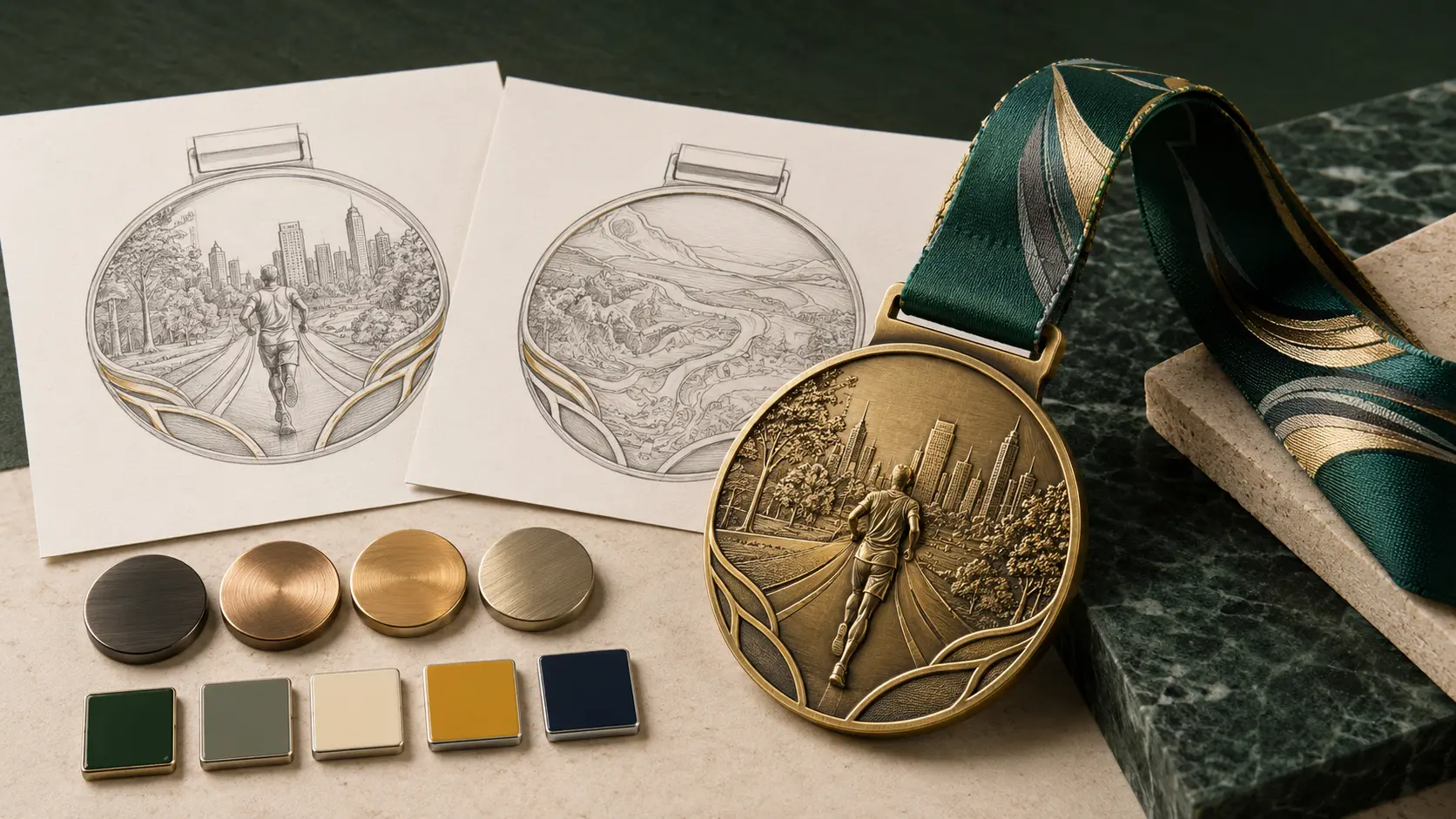
Design for the meaning of finishing
Participants do not all view medals the same way, but many describe a finisher medal as evidence of completing something difficult rather than simply receiving a participation item. That emotional difference should guide the design.
A runner discussion about finisher medals repeatedly returns to pride in completing the distance. Put the achievement—distance, route, event identity or year—at the center of the design instead of treating it as decoration.
Use one memorable silhouette
Complex detail is not the same as a memorable design. A strong outline can be recognized in a finish-line photo and on a display rack. Consider the route shape, local architecture, an animal mascot, a mountain profile, a bicycle, a ball or another event-specific form.
Check the silhouette at thumbnail size. If the main idea disappears, simplify the outline or move secondary detail to the back. Use cut-outs only when they strengthen the concept and leave enough metal for a durable connection.
Make the front readable and the back useful
The front usually needs a clear hierarchy: event identity, visual symbol and distance or award level. The back can carry sponsor logos, a route outline, a short message, serial number or secondary event information.
Small sponsor logos may be better on a custom printed ribbon, backing card or packaging. Forcing too many marks onto the medal face can reduce readability for every sponsor.
Design for display after race day
Running communities frequently ask how to display medals and bibs. That means the medal continues to represent the race long after the finish line. A distinctive outline, legible year and balanced ribbon make it easier to recognize later.
See the recurring display questions in this medal-and-bib discussion. The design does not need to become oversized; it needs a clear identity that remains visible among other medals.
Balance size, weight and ribbon
| Decision | Design question |
|---|---|
| Medal size | Can the core artwork and text remain readable at the final dimensions? |
| Thickness and weight | Does the desired premium feel still suit participant comfort and shipping cost? |
| Ribbon width | Does it visually balance the medal and carry logos clearly? |
| Attachment | Is the loop or connector appropriate for the medal weight and orientation? |
| Packing | Will surfaces stay protected while volunteers distribute medals quickly? |
Review the custom medal size guide before artwork is finalized.
Choose a process that supports the artwork
Use clean 2D relief for typography, flat logos, borders and geometric artwork. Use 3D relief for faces, animals, buildings, terrain and sculpted forms. Soft enamel can create visible metal lines and texture; printing can reproduce gradients and fine color detail that enamel cannot.
The right process is the one that protects the design's main idea at the required quantity and budget. Compare die cast vs die struck medals and UV printed vs enamel medals.
Finisher medal design brief
- Race name, distance, year and required in-hand date.
- Main story: route, landmark, mascot, charity or achievement.
- Quantity and whether different distances need different designs.
- Front and back logo hierarchy.
- Target dimensions and weight direction.
- 2D/3D, plating, color and special-effect preferences.
- Ribbon width, base color and sponsor repeat.
- Packaging and race-day distribution method.
Ask the supplier to flag any line, gap, text or cut-out that may not reproduce clearly before you approve the proof.
Turn your finisher medal design into a factory-ready order
A medal concept becomes quote-ready when the factory knows the finished dimensions, quantity per distance or award level, front and back artwork, 2D or 3D relief, plating, enamel or printing, ribbon and destination. Our Dongguan team can review what is practical at the planned size before tooling and digital proof approval.
For a 100-, 500- or 1,000-piece event, compare the same construction across quantity breaks and ask for tooling, sampling, printed ribbons and freight separately. Sourcing directly from China can help coordinate these decisions at the manufacturing stage; the total delivered price still depends on your country and in-hand date. See our 500-medal budget example and 2D vs 3D comparison.
Send the name, number of medals, rough design, required arrival date and delivery country. We welcome organizers worldwide, including the US, UK and Europe. Plan your race medals or request a factory quote.
Frequently asked questions
What makes a race medal worth keeping?
A clear connection to the achievement, readable event identity, a memorable shape and durable finish make the medal easier to value and recognize later.
Should sponsor logos be on the medal?
They can appear on the back or as secondary elements when space allows. A ribbon, card or package may keep several sponsor marks clearer.
Should I use 2D or 3D relief?
Use 2D for clean logos and text; use 3D for sculpted subjects and organic depth. Mixed 2D and 3D may suit some designs.
Can different race distances use related designs?
Yes. A shared visual system with different colors, shapes or distance details can create a collectible series.
Can names or serial numbers be added?
Personalization can be reviewed. Provide the data format, quantity and placement so the method and production setup can be confirmed.
What artwork should I send?
Send vector artwork when available, plus the race name, distance, year, approved logos, color references and required dimensions. Clear sketches and references can also start the review.
Factory quotation · MOQ from 100 pieces
Turn Your Race Idea into a Production Brief
Send the race logo, distance, date, quantity, required in-hand date and any landmark or theme. We will review the artwork against practical medal construction.